Mastering Modern
Cybersecurity & OffSec
Comprehensive guides covering Network Security, Application Defense, Vulnerability Management (CVE/CVSS/CPE), and Incident Response.
Cybersecurity Pillars
Protecting systems, networks, and data through defense-in-depth principles.
Network Security
Defending network infrastructure, protocols, traffic encryption, and firewalls from intrusion.
Information Security
Safeguarding data confidentiality, integrity, and availability across digital assets.
Application Security
Hardening web and mobile software against OWASP Top 10 vulnerabilities and code exploits.
Incident Response
Detecting, isolating, investigating, and remediating active cyber threats and breaches.
Disaster Recovery
Ensuring business continuity, offsite backups, and quick recovery after technical failure.
Endpoint Security
Securing workstations, mobiles, and IoT devices connected to enterprise environments.
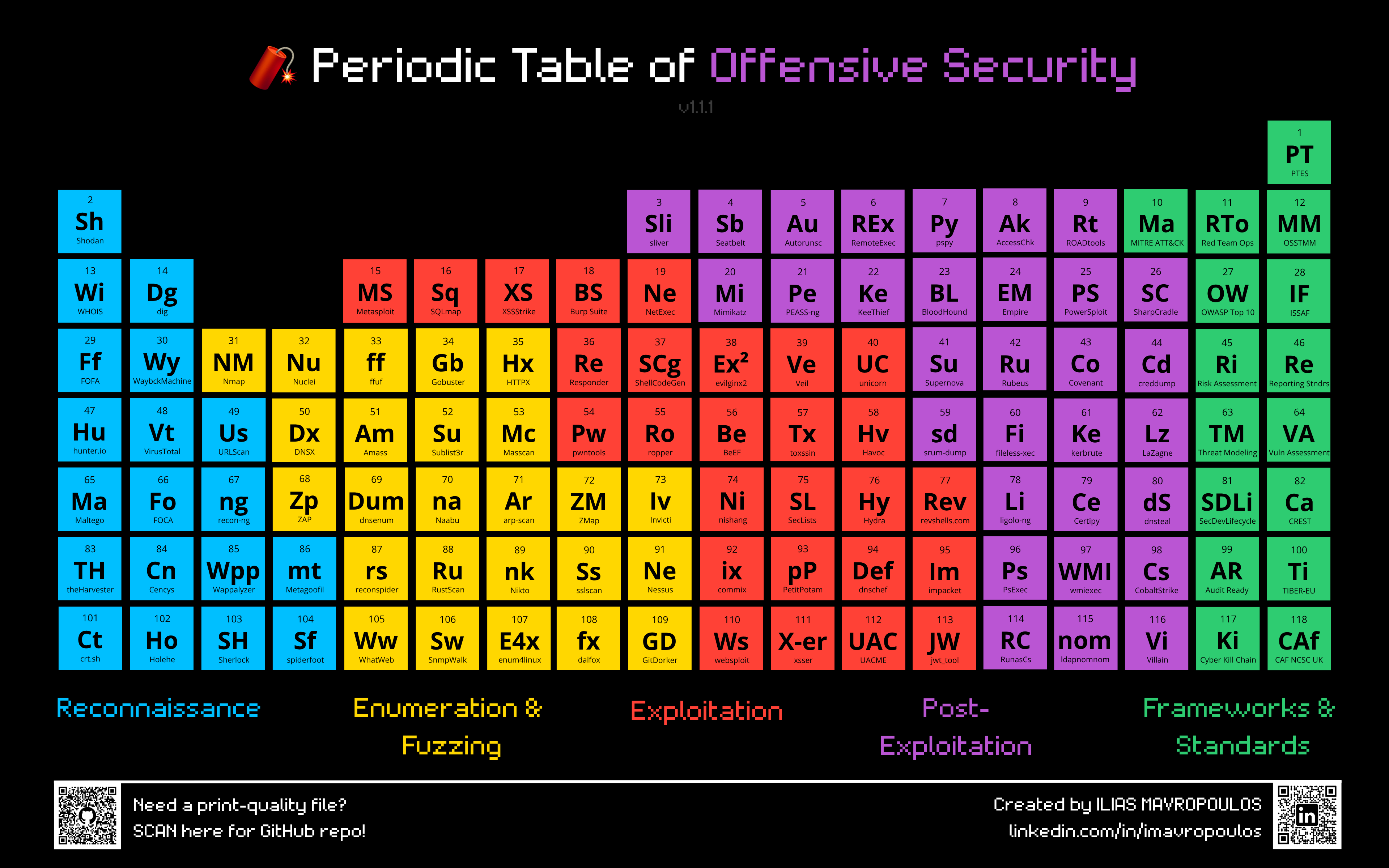
Periodic Table of Offensive Security
A visual breakdown of 118 essential tools, frameworks, and standards used in offensive security and red teaming.
Understanding CVEs (Common Vulnerabilities & Exposures)
Standardized dictionary maintained by MITRE for identifying publicly disclosed software flaws. Each entry receives a unique CVE ID.
Buffer Overflow
Writing data beyond memory boundaries, leading to arbitrary code execution or crashes.
Injection Attacks
SQLi, Command Injection, and LDAP exploits injecting unauthorized input into application backends.
Security Misconfigurations
Default credentials, unpatched services, and misconfigured cloud buckets exposing internal systems.
Cross-Site Scripting (XSS)
Injecting client-side scripts to hijack session cookies, deface sites, or redirect users.
Denial-of-Service (DoS / DDoS)
Saturating network bandwidth or CPU resources to deny service to legitimate requests.
Privilege Escalation
Exploiting OS or app bugs to gain administrative root permissions from a low-privilege user.
CVSS (Common Vulnerability Scoring System)
Standardized 0.0 to 10.0 numerical scale assessing vulnerability severity based on attack vector, complexity, and impact.
CPE (Common Platform Enumeration)
Structured naming format used to uniquely identify hardware, operating systems, and application software releases.